
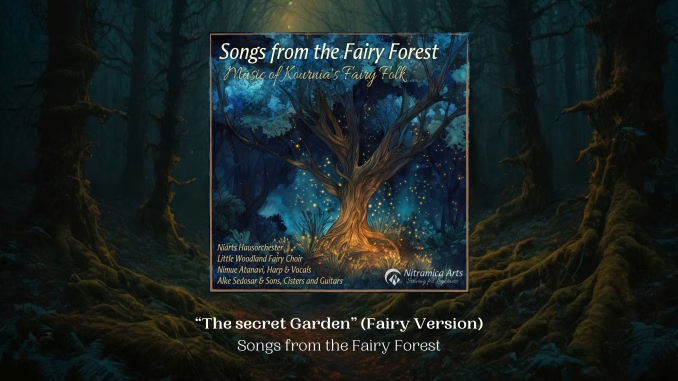
Mit Melodien aus 30 Jahren Nitramica Arts haben wir ein Album mit Feenmusik zusammengestellt, „Songs from the Fairy Forest“, wie sie im Feenwald des Königreiches Kournia gespielt, getanzt und gesungen werden könnten.
Hinweis: Sie müssen angemeldet sein, um die Inhalte dieses Audio-Albums anzuhören.
* * *
Hintergrundinfos zu den Songs

Die Musikerinnen um Skaldin Nimue Atanavi haben mit ihrem Feenmusik-Album die beliebtesten Melodien und Gedichte von Martin Dühning vertont.
Der erste Song, die „Midnight Gavotte“ stammt ursprünglich vom Album „Virtual Seasons“ (2024) und war dort das Halloween-Stück. Das ist als Beginn insofern passend, als das Feenjahr im Herbst beginnt. Gewidmet ist der Song wie schon das Original Veamoris.
Dann folgt „The secret Garden“ – hierbei handelt es sich um eine Neuvertonung des gleichnamigen Gedichts von 2020:
The Secret Garden
Of a secret garden I know, so far away, far from here
– faithful pines, yews, deep beeches and kind limes –
By the water birches and willows stand, deep in the deep ground,
Clear springs bubble up into gentle streams,
Ponds and pools fill, so rich in refreshment,
Within colourful blooming, shining under these wise trees
Entwined with blossoms: Lilies, roses and cosmos,
Borders of blue-rain, laburnum and coneflower
Delighting thousands of butterflies there.
And all the birds: the birds beguile with their lively song
At any time of day. Oh, and the nights smell full of sweetness.
This is truly a place to dream, a lucid way of life,
Enchanted with holy power and magic
And no man’s deceit threatens it, it is pure,
For it is guarded by those who are good of heart.
And from this cordiality the place blossoms
And everyone who is in this garden
Can only become healthy and whole again.
Yes, I know about this garden,
You may have all my knowledge of it – but
Knowledge alone is powerless. Wisdom is impotent:
Cause the way ahead is not so easy to take:
You cannot shorten it, you cannot avoid its obstacles.
You will only find it when you are ready.
You have to walk it yourself, with all your own strength,
Your heart will be tested on the way, every falsehood must fail.
– because the path is the only one that leads to the gate,
And there is no other than this one.
Listen: You must be aware of that at all times:
Once you turn back, it is left forever.
No, you can’t take anything with you,
Because nothing that enters this garden
Will ever be lost again.
And those souls who have entered it,
Are charmed forever.
* * *
Nicht fehlen darf auf einem Feenmusikalbum natürlich „Fairy Christmas“, hier nun in der Woodland-Version, die sich noch einmal von den beiden anderen der Alben „Ninda Christmas – Milony Island Edition“ und „An Evening at Milony Island Castle“ unterscheidet.
„Kaltmond“ und „A Yultide Song“ sind neue Dichtungen:
Kaltmond
Fahl steht der Mond.
Siehst du all die hohen Sterne
Blinken in dem kalten Firmament?
Sag, ob dir die Sterne gerne gäben
Wartend, Ruhend, Weisend
Zukunft, die man dir umsonst geschenkt.
Ach auch schon längst
Tief gesenkt
Hat sich die Sonne,
Kaum auf ihrem goldnen Lauf, so mühsam,
Wispert durch die dunkeltrüben Tannen
Blinzelt zwinkernd,
Mond schweigt stumm.
Träumst, träumst, du jetzt
noch von Sommerszeit,
Sie kehrt einmal doch zurück?
Wenn der Mond sich noch gewendet,
Steigt das Licht nun Stück für Stück.
Schau: Siehst du all,
All die hohen kleinen Sterne,
Wachen über diese kalte Zeit,
Dass die dunklen Geisterreiter,
Bleiben fern und Hilfe naht.
Fahl steht der Mond,
Wir hoffen fort.
* * *
Auch das etwas ältere Gedicht „Tuvstarr und Skutt“ wurde für das Feenalbum variiert:
Tuvstarr and Skutt
Once was my heart of gold;
It drowned me at the ground
Surrounded by, I found
That little bit of hold:
I was a princess, young.
Despite I’m living on
As flowers, as you know:
Even my heart is lost
Deep in the bitter pond,
Until I get it back,
Remain as I will do.
A fellow, kind, like you,
You mighty, courageous moose
Others would have complied –
And I have lost my crown,
And I have lost my grace,
I was too green in mind
And knew zilch of the world.
I’m paying now the price,
And I lost everything:
Nothing – remains of me
As flowers I persist.
There, high up in the north
Are many ponds and pools:
Still, black, possibly cursed,
In forests deep, they hide.
Fir trees and wacky pines,
Circled around their banks:
Sometimes they bend their tips,
Forward, to see what is
Hidden in water’s depths.
Down there, too, great woods lie,
Down there, too, great hopes lie,
Silence surrounds them softly,
Silence of golden hearts.
* * *
„Another Christmas Day“ ist eine sehr unabhängige Interpretation von „Fairy Christmas“, „The Wild Hunt“ und „Haunts of Winter!“ sind Vertonungen zweier weiterer Gedichte, wobei „Haunts of Winter“ ursprünglich den Titel „The Forest Fairy“ trug. „Trough the Winter Forest“ ist ein Instrumentalstück, was zwischen den beiden Gedichtvertonungen eingefügt wurde.
The Wild Hunt
There are things between heaven and earth, that are not yours
And they cannot be banished with knowledge or power,
For they all must follow the sun’s preordained course:
Rising at the end of times, in-between, when shadows move,
Thoughts foremost, murky swaths from the land of Before,
Whispering first, then moving with laughter over your horizon.
Yeah, first they are a vague guess, but then they become manifest.
Beware in the time between the years, in the Twelfth Night beware,
Beware of wandering alone through the endless mirky woods
That are with deep ponds, forgotten memories without ground,
Do not look down! Do not look back! Do not look in! Above all:
Do not expose yourself – keep away from these shadow realms!
In every branch there lurks a bugbear, for the fairies are all gone,
Now, between the dark stones, there cavort merciless trolls only.
And yet, even in these times of darkness, there is hope:
Within us all is given a holy flame that infuses everything,
That keeps our inner light shining in the darkest of hours.
It keeps us safe in the here and now – if we kept it in time.
But whoever is dark in his heart, no worldly luminaries will help.
For darkness penetrates windows, doors, even massive walls
And no man can save you, when the Wild Hunt calls!
* * *
Haunts of Winter
(The Forest Fairy)
Tell me, my old friend:
Where have the foxes gone?
They sleep in their dreams
Of endless love, charity
Which never ends.
You have been told, my friend
That luck lies far away
But sense comes from within,
the inner light of hope
gives warmth in winter days, like these.
Be sure, fair friend:
Even though this night reigns
In a restless, harsh world, like this,
You can be sure,
That nothing, that heals,
Ever is truly lost.
Nothing is truly lost.
* * *
Ebenfalls auf zwei Gedichten basieren die Songs „Telia’s Lament“ und „Shae’s Invocation“. Beide Stücke gehören zusammen: „Telia’s Lament“ verkörpert den melancholischen Blick auf das Vergangene, „Shae’s Invocation“ auf Gegenwart und Zukunft.
Telia’s Lament
The magic of the old lands is gone, the forest is down,
The wizards have departed, the charm is lost,
Yes, a little mockery would not have hurt –
But the criticism was too much and helping hands were missing
And since nothing can come from pure reason –
Because logic is only order and not fullness –
Disintegrated again into the tides,
What arose from them.
I do not want to complain about the loss, over is over,
But that there are no more magicians to come…
And no fairies, yes, because none of you believe in magic anymore.
And all this know-it-all talk from people who stand by and watch
While a paradise fades away. Alas!
As if this had not been experienced often enough…
It takes half a century to grow a forest,
It takes a lifetime to create a home, but
It takes only a few days to raze it all to the ground.
* * *
Shae’s Invocation
I carry new brightness, I hold the star,
I sit at the spring, purify it with starlight,
I ask from heaven new green and new plants,
I make alliances and find new friends,
I wait where others despondently gave up,
I find what others abandoned and forgot.
In Nimbre the fairies are living again,
And in fresh woods hope is greening anew:
We leave the shadows from past far behind,
We banished the draugrs – lightness shines anew,
We have kept our faith where others have paled and
We will bravely defend what is our new home.
May the Oldlands of folly have perished,
May ancient sagas elsewhere have damned,
Let others tread dust ’nd desert in old home,
But we shall never again despair and flow,
We’ll enjoy with lightness new shelters.
And nothing will rob our forces this time,
And no one will ever again diminish our shine –
And we will with might help all
friends who trust us.
* * *
„Spring Dance of the Fairies“ ist das erste Frühlingsstück im Album, was wieder eine etwas schnellere Melodie einbringt und wandelt zwischen keltischer Folklore und Barock. Der Waldtroll-Remix von „Sternensehnsucht“ ist ebenfalls etwas kräftiger intoniert.
„Alan the Bard“ basiert auf einer Melodie, die mir einst von Flötistin Sarah aus dem sonnigen Süden mitgebracht wurde. Die Melodie stammt ursprünglich aus einem traditionellen Volkslied vom Balkan. Da sie modale Skalen und recht ungewöhnliche Taktarten einsetzt, war sie sehr schwer im Satz zu vertonen.
„The Festival of the Hares“ vertont ein weiteres Gedicht von Martin Dühning. Der (abgewandelte) Stoff stammt aus einem dänischen Kinderlied. Für diese Vertonung wurde noch ein Refrain eingebaut:
The Festival of the Hares
On top of a green, green, green, green summer hill
I saw two hares coming,
One was playing the flute, the flute, the flute,
The other a drum he was beating.
Here you see: so we are,
Whatever happens, happens,
It will be, as it will be.
Next came an ugly, ugly hunter-hunter-hunter man,
He shot the one hare down,
And the other one, as you can imagine, imagine, imagine,
He felt so lonely and he lamented.
Here you see: so we are,
Whatever happens, happens,
It will be, as it will be.
That watched the little green, green, green, green fairy,
It made her terribly mad
and she turned, turned, turned
the evil huntsman into old cold stone…
Here you see: so we are,
Whatever happens, happens,
It will be, as it will be.
And a stone will ever be a stone…
* * *
„Flute of Beltaine“ entstand ursprünglich aus einer spontanen Improvisation auf einer Yamaha-Tenorblockflöte an einem 1. Mai (daher der Name).
Für das Album gibt es auch eine neue Fassung des Gedichtes „The Elder Tree“, was von E. T. A. Hoffmanns Holunderbuschvision aus „Der Goldne Topf“ inspiriert ist:
The Elder Tree
That’s the evening sun, which plays in me
Which peals like a bell with blue eyes.
Fairy-tale snakes that bask in the branches
Like golden green emeralds
And sound like distant flutes
At Beltaine.
You lay dreaming in my shadow,
My scent surrounded you,
But you did not understand me.
I caressed your curls, tickling your chin,
I played around your temple tenderly,
But you did not understand me.
Breath is my language
When love solemnly lights it.
Like sunbeams broke through the clouds,
The inner light in words, blossoming:
I poured gold around you, precious sparkling,
But you did not understand me.
That’s the evening sun, which plays with me,
You said, a springtime breeze and some birds,
Which sounds like bells, rustling blue rye.
Embers are my language when they ignite love,
I whispered softly to your heart,
But you did not understand me,
You didn’t understand me.
* * *
„The Deers of Deersborough“ ist eine Neufassung der „Chaconne for Salome“ aus dem Album „Solitude“ (2017). Diese Variante ist all den kleinen Rehen und Hirschen gewidmet, die an den Ufern des kournischen Flusses Entwinnen im Wildpark des New Deersborough Forest grasen.
Ganz neu für dieses Album wurde „Aishling’s Song“ erdichtet und vertont. Aishling Atanavi ist ein Troll-Feen-Mischling, die Tochter von Grünfee Telia Atanavi und Vladimir, dem Waldtroll:
Aishling’s Song
What I am,
I don’t know,
And I don’t care.
My father is a forest troll,
My mother is a green fairy,
And when I look in the mirror lake,
I see myself.
Just call me Aishling,
Aishling, Aishling,
That’s me.
What I am,
That’s just who I am,
I’m never cold in winter,
Summer is great,
I jump over sticks and stones,
Climb over all the vines,
Without wavering, in my mind,
I see what I see.
Just call me Aishling,
Aishling, Aishling,
That’s me.
What I am,
I know well,
I am the fairy’s friend,
Polly, Nuuba, Belion,
Rejoice from afar,
Bring them new tidings,
Dance joyfully in their circle,
Without sorrow, without need,
From morning until sunset.
Just call me Aishling,
Aishling, Aishling,
That’s me.
Who you are,
I don’t know,
If you’ve ever been to the fairy forest,
If you have a good soul,
If you don’t lack love,
If you love animals and plants,
You’ll surely like it here:
Dance happily with our circle,
Night and morning, every hour.
Let’s just be friends,
Just call me Aishling,
Aishling, Aishling,
That’s me.
* * *
Es folgen drei weitere Instrumentaltänze: „Summer Tedesca“ und „Three dancing old Ladies“ (under the Linden Tree) aus dem Album „Lord Milony’s Summer Dances“ von 2014 sowie die Neukomposition „Summer in Nimbre“.
„The Forest’s Tribute to Radegund“ ist der gleichnamigen Künstlerin und Tierfreundin gewidmet. Hier verneigt sich der gesamte Feenwald vor einer großen Seele mit zauberhaftem Charakter.
Auch der Titel „Festival of the Autumn Queen“ ist einer realen Person gewidmet – Ilse – die ein fantasiereicher Mensch mit viel Herz und Weltoffenheit war.
Schlussstück bildet „Endless Beauty“ – die Melodie stammt aus Martin Dühnings Elven Symphony von 1996, der Text ist William Shakespeares „Sonnet 104“.
Zur Instrumentation
Die Stücke werden von virtuellen Instrumenten gespielt, dabei kommen auch explizit (virtuelle) Folkinstrumente zum Einsatz, neben den obligatorischen keltischen Harfen, Renaissance Laute/Theorbe, Irish Bouzouki, Mandola, Western Gitarre, Oboe, Sopransaxophon und diversen Flöten auch Nyckelharpas, Dulcimer und Violas da Gamba. Sämtliche Stimmen sind (leider) auch künstlich (KI), allerdings ist hier die Qualität meist schon recht beachtlich. Weniger überzeugen im Vergleich dazu die Instrumente, weil die Software hier oft leider die Obertöne abgeschnitten hat (welche den wesentlichen Charme diverser Instrumente ausmachen).
Ausblick
Das sind weitaus noch nicht alle Melodien und Texte, die man im Feenwald von Kournia singt, weshalb es von diesem Album wohl noch eine Fortsetzung geben wird.
Außerdem bin ich mit der Tonqualität noch nicht zufrieden, weshalb es künftig, mit hoffentlich besserer Software, noch eine Remastered-Fassung geben soll. Wobei es natürlich am Schönsten wäre, wenn zumindest die besten dieser Melodien hier vielleicht auch mal von realen Musikern gespielt werden würden, so im Stile der Gruppe „Quadriga Consort“ um Nikolaus Newerkla oder der Folk-Gruppe Naragonia, die ich beide sehr verehre.


